

A Certain Experiment Has Three

What's the probability of getting a perfect GRE Quant score? While you don't have to be a math whiz to score highly on the GRE, you practise demand to be able to empathise the basic concepts beingness tested, ane of which is probability. Knowing what kind of GRE probability questions to expect will give you lot a niggling more confidence on Quant — and help enhance your Quant score!
In this extensive GRE probability review, we'll start past covering what probability is and the ways information technology's presented on the GRE. Then, we'll teach y'all all of the basic rules and formulas you need to know as well equally give y'all tips for studying probability and approaching GRE probability questions on test day.
An Introduction to GRE Probability
Probability is a sub-topic of data assay, ane of the four major math topics tested on Quant (in addition to arithmetic, algebra, and geometry). Dissimilar these larger topics, still, probability doesn't play a significant office on the GRE. In fact, y'all'll probably encounter but a couple of GRE probability questions in total — typically no more than two or three.
Still, it'south important you lot empathise what probability is and how information technology's often tested on the GRE. This mode, you'll be able to solve for the correct respond, ultimately raising your chance of achieving a high Quant score.
So what exactly is probability? In math, probability is a way for united states of america to describe dubiety and the possible outcomes of an experiment using numbers. These numbers betoken the likelihood of a certain event or group of events occurring and can be written as integers, decimals, or fractions.
On the GRE, probability questions can have on a diverseness of formats, including multiple choice, Quantitative Comparison, and Numeric Entry. Whether a question calls for fractions or decimals is usually clarified by the question or answer choices. Thus, a probability question discussing probabilities in decimals volition probably ask for an reply in decimals. Answer choices, if supplied, are typically written either all in decimals or all in fractions.
If you lot are answering a Numeric Entry probability question, look closely at the bare to determine how you should write your respond. A single blank means the question is looking for either an integer or a decimal. A double blank (with a numerator and a denominator) means the question is looking for a fraction. (Note that yous are not required to reduce fractions on the GRE; any equivalent fraction volition count as a right answer!)
GRE Probability: 16 Concepts You Must Know
Yous now accept a fairly clear idea of how GRE probability questions await and are presented on the exam, so let's move on to the math itself. What are the major terms, rules, and formulas you must know in order to sympathize GRE probability questions? Read on to find out.
GRE Probability Terms
Below is a list of probability-related terms you lot're most likely to encounter on the GRE:
- Random experiment: an experiment with an uncertain outcome
- Outcome: the result of a random experiment
- Effect: a particular event or set of outcomes of a random experiment
- Sample space: the set of all possible outcomes of a random experiment
- Mutually exclusive: 2 or more events that cannot occur simultaneously
- Contained: when the occurrence of one event does not affect the probability of the occurrence of another outcome
- Random selection: the selection of an item from a sample space wherein all items are every bit likely to exist selected
GRE Probability Rules
Now, let'south acquire about the math behind probability. Probability is usually denoted past P and can be written as P(E) to indicate the probability of a sure event occurring. The major rules are as follows:
- The probability of an result occurring always ranges from 0 to 1.
- If an event is certain to occur, the probability of that event occurring is equal to 1 and can exist written as:
$$P(East)=ane$$
- If an event is certain not to occur, the probability of that upshot occurring is equal to 0 and can be written equally:
$$P(E)=0$$
- Almost events fall somewhere within this range of 0 to 1 and have low, medium, or loftier chances of occurring. This concept tin be written as an inequality:
$$0<P(E)<i$$
- To solve for the probability of an event not occurring, decrease the probability of the event occurring from i. This looks like:
$$1-P(E)$$
- The sum of the probabilities of all possible outcomes of an experiment is always equal to 1.
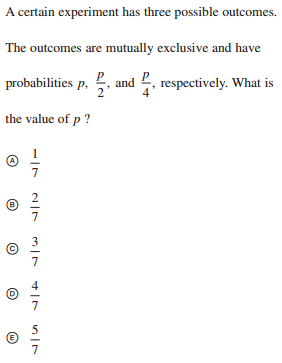
Here, we have a multiple-choice probability question asking for an respond in the form of a fraction. In this question, a certain experiment contains iii possible outcomes that are all mutually exclusive. (In other words, all of these outcomes must occur separately.) These 3 outcomes arep, $p/2$, and $p/four$.
According to the rules of probability, the probabilities of all outcomes of an experiment ever add up to ane. In this case, the only 3 possible outcomes we have, denoted by their probabilities of occurring, arep, $p/2$, and $p/four$. Therefore, we can add all of these upward to get 1, writing our equation every bit and so:
$p+{p/2}+{p/iv}=i$
Accept a moment to examine the equation. Hopefully, you've noticed there is but a single variable in it:p. Considering we're being asked to find the value of p, all we take to do now is use algebra to simplify our equation and solve for p. The easiest way to practice so is past multiplying each term past 4 and and then combining like terms:
$4p+{4p}/2+{4p}/iv=iv$
$4p+2p+p=4$
$7p=4$
$p=4/7$
The correct respond is D: $4/7$.
GRE Probability Formulas
Got your terminology downwardly? Keen! Now, let'southward continue our GRE probability review by taking a wait at the major probability formulas you'll need for Quant.
For a Unmarried Outcome
$$P(Due east) = {\number \of \successful \outcomes} / {\total \number \of \possible \outcomes}$$
- This is a basic formula and by far the virtually commonly used GRE probability formula.
For Two Independent Events
$$\Probability \of \two \independent \events \occurring = P(A) * P(B)$$
- P(A) = probability of event A occurring, P(B) = probability of event B occurring.
- Think of this equation as if you lot were rolling a regular six-sided die. Rolling a iv, for example, does not affect whether or not you'll whorl a 6 on the adjacent roll. The two events are therefore independent, and so the probability of rolling a 4 and then a 6 can be written as ${i/vi}*{one/6}=i/36$.
For Two Mutually Exclusive Events
$$P(A \or B) = P(A) + P(B)$$
- $P(A \or B)$ = probability of event A or event B occurring.
- Let's retrieve virtually a regular six-sided die again. In this instance, we're just rolling our die once. If nosotros are hoping to gyre either a 2 or a 5, the two events are clearly mutually exclusive, as at that place is no possible fashion of rolling both a 2 and a v on the aforementioned plough. So, the probability of rolling a 2 or a 5 on a single roll is equivalent to the sum of their probabilities: ${1/half dozen}+{ane/6}=two/6=1/3$.
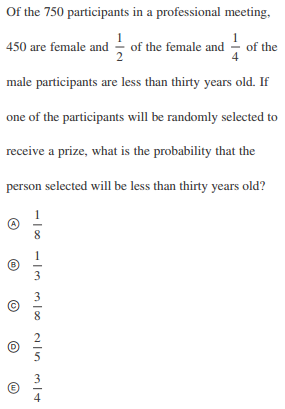
Hither's a piddling GRE probability practice for you. In this question, nosotros're being asked to solve for the probability of randomly choosinga person (male or female) who is less than 30 years old.
Let's get-go with what we know. In that location are 750 participants in total. 450 of them are explicitly described as female; therefore, we tin can presume 300 are male. Half of the female participants are less than xxx years old, so $450/ii=225$. In addition, $1/four$ of the male participants are less than 30 years old, then $300/4=75$.
We now know at that place are 225 female participants nether thirty and 75 male participants nether 30. But what nosotros desire to know is the probability of choosing whatsoever person (male or female) under 30. Add together these ii values together to get the full number of participants under 30:
$225+75=300$
This tells us 300 participants are less than 30 years old. Out of a total of 750 participants, the probability of choosing a person less than 30 years old is therefore $300/750$.
But none of the respond choices in a higher place comprise this particular fraction, so permit'south attempt reducing our answer. 300 and 750 can both be divided by 150 to become $ii/five$, which is the same as reply pick D.

3 Tips for Budgeted GRE Probability Questions
Probability doesn't brand upwardly a particularly large part of the GRE, but you're jump to have at least a couple of probability questions scattered throughout the test. Here are some of our best tips for approaching GRE probability questions.
#ane: Confirm the Focus is Probability
Earlier being able to solve a probability question, you lot must first be able to successfully place one on the test. A majority of GRE probability questions utilize the term "probability" in their descriptions. If you're not finding this discussion, though, look for other probability-related terms and phrases in the description. Mutual ones include:
- Upshot
- Outcome
- Randomly selected
It can be tempting to movement swiftly on test 24-hour interval, butbrand sure you lot're paying attending to what the questions are asking you to solve. I possible mistake you might brand is confusing a proportion question for a probability question. Proportion questions are arithmetic-based and concentrate heavily on ratios and percentages —non probability. But these two types of questions tin take similar shapes on the GRE. For example:
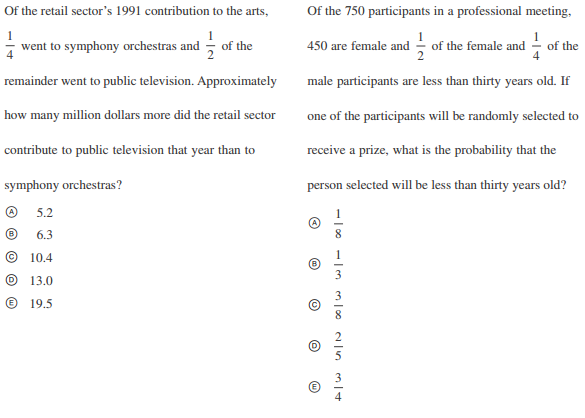
At a glance, the two questions above look as though they're probably dealing with identical concepts. After all, both are discussion-based questions containing fractions. Additionally, the first question offers decimals for respond choices (which could signify probability), and the second question offers fractions for answer choices (which could also signify probability).
But look more closely and yous'll see the first question is in fact focused entirely on proportions and arithmetic. There is no mention of probability or any key probability-related terms or phrases. The second question, on the other mitt, uses the phrase "randomly selected" and is asking you to notice a specific probability.
In the end,always make certain y'all are reading the questions diligently and identifying keywords so that y'all know exactly what yous'll be solving.
#2: Determine a Direction
Another strategy you can use is todecide a direction.Here's what I mean: many probability questions await yous to solve for the probability of an event. Others, notwithstanding, might ask yous to work backward, starting with a probability and expecting you to instead solve for a specific number, such as the full number of people in a group or a sure number of items in a sample space.
To decide which direction to take in a probability problem, expect at both the description and reply choices. If you are given a full number of items in a sample space from which something has been randomly selected, you will likely solve for the probability of choosing something. If, however, you start with a probability, you'll probable have to work backward to solve for a specific number or corporeality.
Take the post-obit instance:
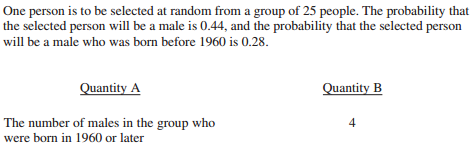
In this Quantitative Comparison question, we're beingness asked to compare an unknown value with the number 4. Quantity A is not a probability but rather a number of specific people in a group. So instead of solving for a probability, nosotros'll exist working astern, using the probabilities given to us in the clarification to look forthe number of males born in 1960 or afterwards.
Allow's begin. The problem states in that location are 25 people in a group. If the probability of a male being selected is 0.44, we can use this information to figure out how many males there are in total. Recall, decimals are substantially the same equally fractions. If the total is 25 people, our probability of choosing a male person is therefore $x/25$, which should, when converted to a decimal, equal 0.44. Here's how to set it upwardly:
$x/25=0.44$
Now, solve for x:
$10/25=0.44$
$x=0.44*25$
$ten=11$
Co-ordinate to our calculations, there are 11 full males in this particular group of 25 people. Now, let'southward look at the males born earlier 1960. The probability that a male chosen was born earlier 1960 is 0.28 (out of a total of 25 people, not 11 males). Mimic the procedure higher up to calculate how many males in the grouping were born before 1960. Hither, we'll use a unlike variable, y, to represent the number of males built-in earlier 1960:
$y/25=0.28$
$y=0.28*25$
$y=7$
We at present know 7 of the 11 males in the group were born before 1960. Simply the question is asking the states for the number of males born in or after 1960. We tin can employ subtraction to get the answer:
$11-7=4$
4 males were built-in in or after 1960. Because 4 is equal to Quantity B, the correct answer is C: The two quantities are equal.

#3: Plug In Numbers
For the most function, yous should be able to solve GRE probability questions using a combination of algebra and arithmetic. But some questions might exist purposely vague or complicated. In these situations, plugging in numbers is a adept manner to either solve for an respond or double-cheque an answer yous've come up up with using a unlike method.
Permit's look dorsum at the sample question higher up on three mutually sectional outcomes (p, $p/two$, and $p/4$):
Previously, we used algebra to solve for p, as all of the events are defined using the aforementioned variable. But allow'south say you weren't sure how to solve the equation you lot came upwards with. Another style of solving this problem is by plugging in each of the answer choices. Nosotros already know the probabilities of all three possible outcomes must equal ane when added together (per the rules of probability). In algebra, this looks similar:
$p+{p/2}+{p/four}=1$
Now, let'southward start plugging in some of our respond choices. Always make sure to commencement with C, or whatsoever the middle value is, and then you'll have a rough idea of whether you should piece of work up or down to get a higher or lower event. Here's what the equation looks similar when we plug in C ($3/7$) to our equation:
${three/7}+{(3/7)/2}+{(three/7)/4}$
$0.43+0.21+0.11=0.75$
If this question were on the test, you could apply your on-screen estimator to solve each fraction individually before combining all of the terms. Our result is 0.75, which is pretty close to 1 merely a little lower than the answer nosotros're looking for. And then, let's try D, which is a slightly larger fraction, and run across if we can get a higher result:
${4/vii}+{(4/seven)/2}+{(iv/7)/iv}$
$0.57+0.29+0.fourteen=1$
Answer choice D gives us 1 and is therefore the correct answer choice. Note that this is the aforementioned answer we reached previously when using algebra to solve the equation! As y'all can meet, it doesn't matter what method you choose — just as long as you're able to come with the right respond.
How to Written report GRE Probability
Before yous take the GRE, it's a adept idea to spend some time familiarizing yourself with probability concepts and practice questions. Here are some of the top report strategies we recommend for GRE probability exercise.
#1: Review Key Concepts
Many GRE probability questions will require yous to utilise algebra and/or arithmetic in gild to get an reply. Therefore, make sure you know how to exercise the following:
- Set up upwardly proportions
- Employ cross multiplication
- Reduce fractions
- Convert a fraction into a decimal (you lot can utilise the on-screen calculator for this)
- Add and multiply fractions
- Fix an equation with variables
Additionally, be certain you sympathise all of the major probability-related terms and rules defined above so yous can ready equations without hassle.
#2: Memorize Formulas
Some other crucial component of GRE probability practice is memorizing central probability formulas. As previously stated, at that place are three major probability formulas, but the one for solving the probability of a single effect occurring is by far the GRE's favorite. Again, this formula is:
$$P(E)={\number \of \successful \outcomes}/{\total \number \of \outcomes}$$
Make certain you lot diligently practice this formula and sympathise how to utilize it to solve for a specific probability. On the exam, you're not e'er simply solving for a probability, though; sometimes, you'll begin with a probability and accept to work backward to find a specific value. Knowing how this formula works, then, can allow you to use information technology to a multifariousness of probability problems, even if y'all're non directly solving for a probability answer.
#iii: Use High-Quality Study Materials
Every bit with whatever GRE topic, always stick to the highest quality written report materials so yous tin can exercise realistic probability questions and familiarize yourself with how probability volition appear on the GRE. Feel gratis to check out our top choices for GRE prep books and our summary of the best resources for GRE math practice. As ever, opt for official resources whenever possible.
Furthermore, exist certain totake reward of official practice tests. With these tests, yous'll go used to how often probability appears on the exam and larn firsthand how to tackle these questions no matter when or how they come upward. ETS offers 6 practice tests free of charge, and we cover all of the details of these tests in our in-depth guide.
GRE Probability: Recap
Probability doesn't have up a lot of space on the GRE, but information technology's a critical concept you lot should spend a decent corporeality of fourth dimension studying, especially if your ultimate goal is to maximize your Quant score.
Before sitting for the exam, be sure to memorize the most important concepts associated with probability, including all of the major terms, rules, and formulas. Most GRE probability questions will require you lot to utilise, in one way or another, the basic probability formula, which is:
$$P(E) = {\number \of \successful \outcomes} / {\full \number \of \possible \outcomes}$$
Our comprehensive GRE probability review has given you tons of exam-day tips:
- Know how to place a probability question
- Determine whether y'all need to solve for a probability or work backward and solve for a specific value
- Plug in reply choices, starting with the middle answer choice (C), if you lot're unsure how to use algebra to get an reply
When studying GRE probability, try to dedicate ample time to the following:
- Reviewing key concepts, including the basics of arithmetics and algebra
- Memorizing probability formulas, particularly the one for a single event
- Practicing with high-quality prep materials, including books and official GRE practise tests
Call up, your probability of scoring highly on Quant will ascension the more than you study and practice specific concepts, and so don't forgo GRE probability practice. Go studying and y'all'll be acing probability questions in no time!
What's Next?
What else is on Quant besides probability? Check out our detailed math review to larn more about the myriad of topics tested on the GRE.
Demand tips for studying? Take a expect at our comprehensive resource for the best math practice you tin can get, and read all almost our height strategies for using PowerPrep.
Want specific strategies for exam day? If y'all'd like to larn how to employ your scratch paper or how to utilise the on-screen computer, we've got you covered!
We've written a eBook well-nigh the elevation 5 strategies you must be using to have a shot at improving your GRE score. Download information technology for free now:


A Certain Experiment Has Three,
Source: https://www.prepscholar.com/gre/blog/gre-probability-questions-review-practice/
Posted by: mclendonbobloventold.blogspot.com
0 Response to "A Certain Experiment Has Three"
Post a Comment